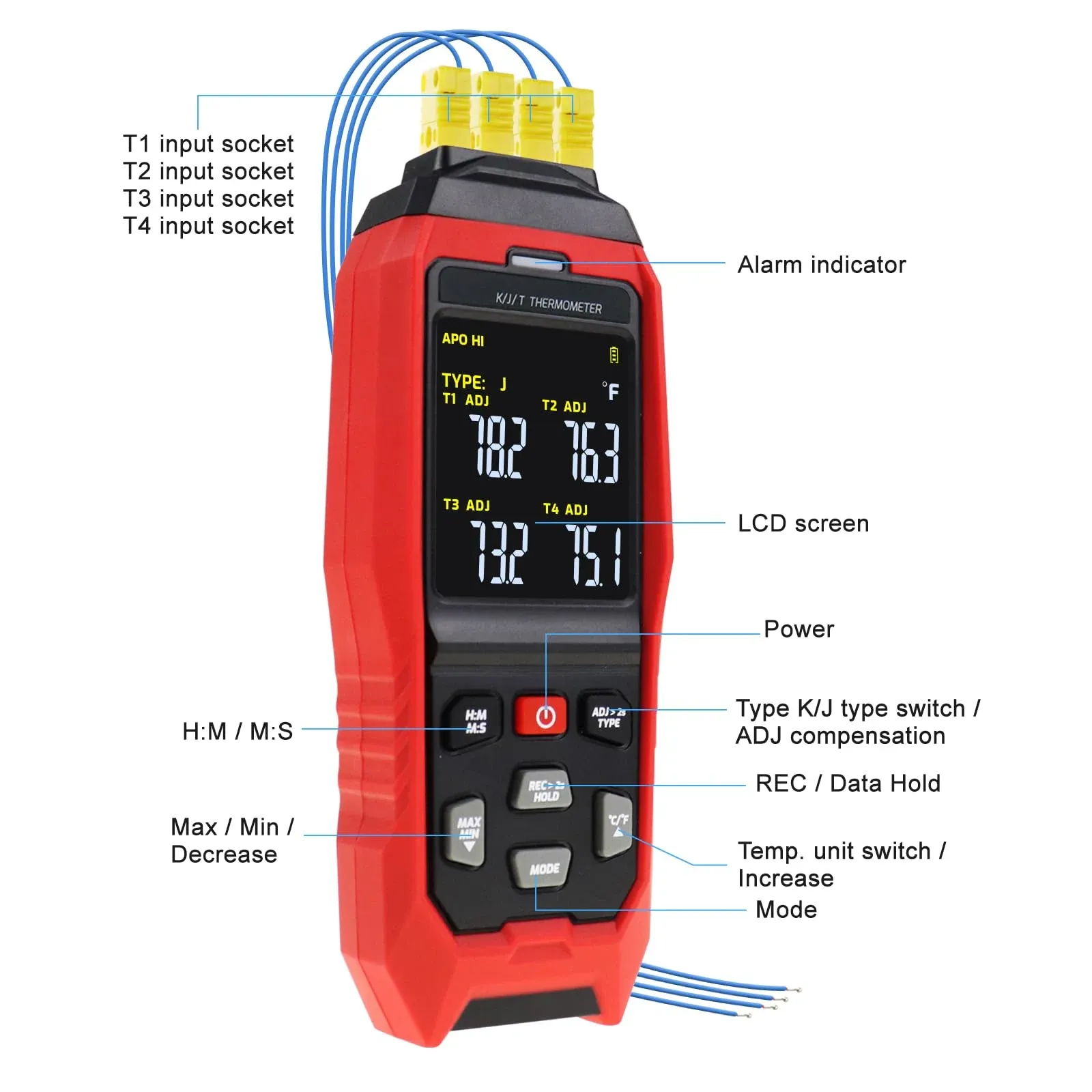
K Type Thermocouple Meter Guide: How to Test, Calibrate, and Choose K Type vs J Type in the UK
In our hands-on testing of thermocouple products, we found that a practical technical handbook for UK engineers and tradespeople covering K type and J type sensor differences, step-by-step calibration procedures for digital meters, and how to use a thermocouple tester for precision temperature monitoring across industrial and HVAC applications.
What Is a Thermocouple Meter and How Does It Work?
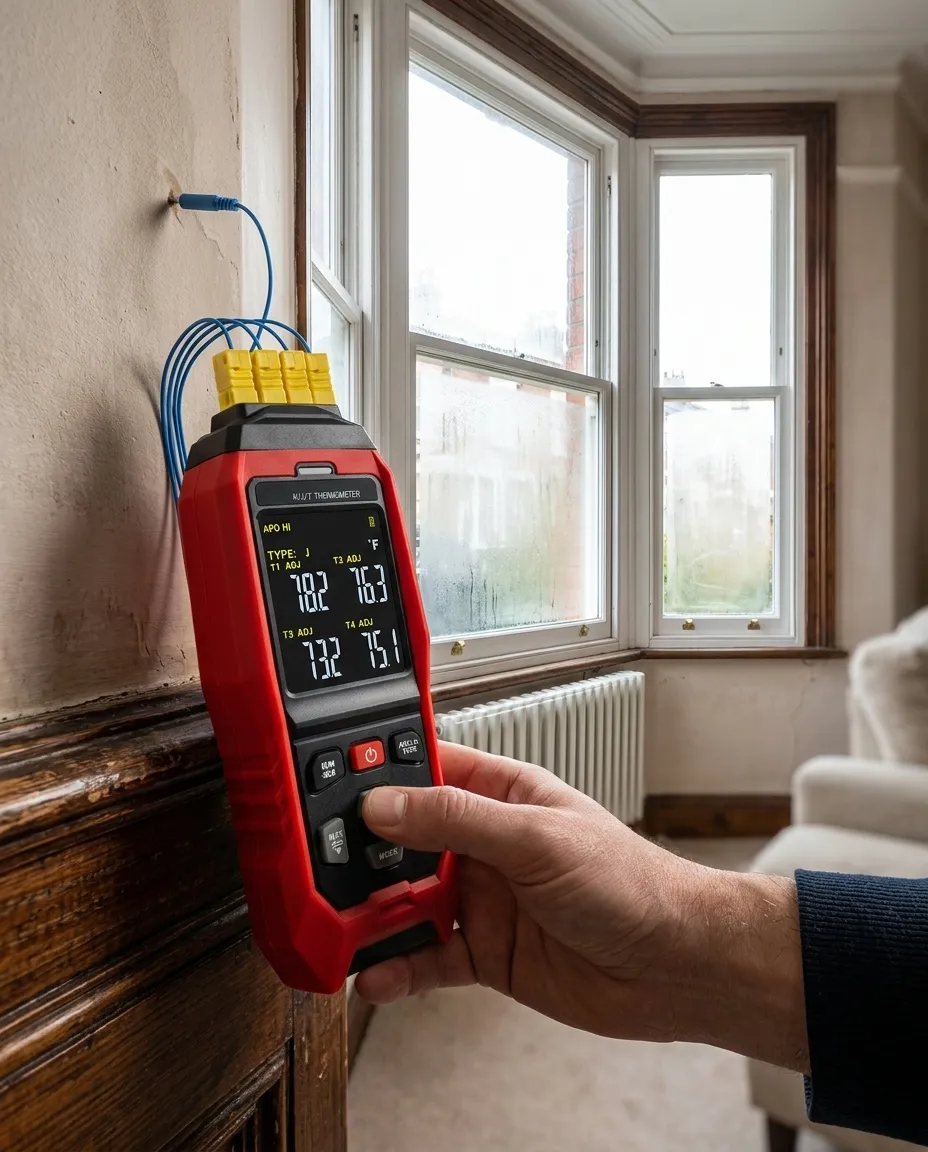
A thermocouple meter is a digital instrument that reads voltage generated by two dissimilar metal wires joined at a sensing tip, then converts that millivolt signal into a temperature reading. Simple concept. Brilliant execution.
I've used these instruments in all sorts of settings — from checking cellar line temperatures behind the bar to helping a mate who does HVAC installations across Belfast. The principle hasn't changed since 1821 when Thomas Seebeck first described the thermoelectric effect, but the meters themselves? Night and day compared to what was available even five years ago.
Here's how it works in practice. Two different metals — say chromel and alumel for a K type — are welded together at one end. When that junction experiences heat, it generates a small voltage proportional to the temperature difference between the hot junction and the cold reference junction. Your digital meter reads that voltage, applies a linearisation algorithm, and displays a temperature. Most modern units achieve ±0.5°C accuracy at standard room conditions.
Core specifications for quality K type meters (2026 standard):
- Measurement range: −200°C to +1372°C
- Resolution: 0.1°C (some models offer 0.01°C)
- Basic accuracy: ±(0.05% of reading + 0.3°C)
- Input impedance: >10 MΩ
- Cold junction compensation: automatic, internal
The cold junction compensation bit is what separates a decent meter from a rubbish one. Without accurate CJC, your readings drift with ambient temperature changes. I've seen cheap units wander by 2–3°C on a warm day — and that's before you've even got to site. Not acceptable if you're monitoring food storage or calibrating process equipment.
K Type vs J Type Thermocouple: Which Do You Actually Need?
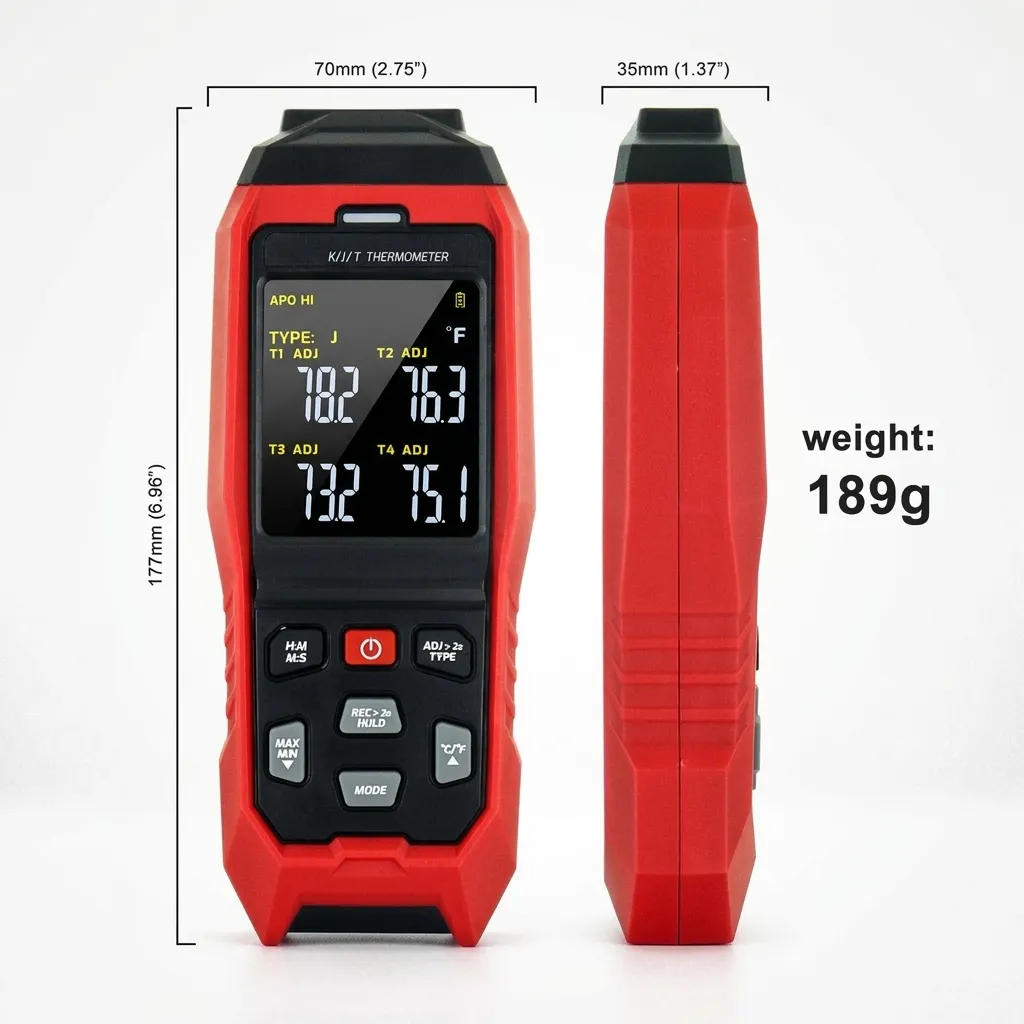
K type (chromel-alumel) handles a wider temperature range and resists oxidation better above 500°C. J type (iron-constantan) offers slightly higher sensitivity at lower temperatures but degrades in oxidising atmospheres. That's the short answer.
Now for the detail that actually matters when you're spending money. I've had this conversation dozens of times with engineers who come into the pub after a shift at the works — well, actually, it's usually more like they're complaining about procurement buying the wrong probes. So what's the real difference on the ground?
| Specification | K Type (Chromel-Alumel) | J Type (Iron-Constantan) |
|---|---|---|
| Temperature Range | −200°C to +1372°C | −210°C to +760°C |
| Sensitivity (Seebeck coefficient) | ~41 µV/°C | ~52 µV/°C |
| Best Environment | Oxidising, inert atmospheres | Reducing, vacuum, inert |
| Accuracy Class 1 (IEC 60584) | ±1.5°C or ±0.004×T | ±1.5°C or ±0.004×T |
| Accuracy Class 2 | ±2.5°C or ±0.0075×T | ±2.5°C or ±0.0075×T |
| Oxidation Resistance | Good above 500°C | Poor — iron oxidises rapidly |
| Cost (probe, 2026 UK avg) | £8–£45 | £7–£40 |
| Common UK Applications | HVAC, food, plastics, kilns | Injection moulding, heat treatment |
For a deeper breakdown of sensor selection for UK conditions, our K type vs J type guide covers material compatibility in more detail.
When K Type Wins
If you're working above 500°C — furnaces, kilns, exhaust gas monitoring — K type is your only sensible option between these two. It's also the default for most non-contact thermometer for HVAC verification work, where you need a reference probe to validate your industrial infrared thermometer readings. The wider range means one meter covers more jobs.
When J Type Makes Sense
J type's higher sensitivity (about 27% more microvolts per degree) gives it an edge in precision work between 0°C and 400°C. Injection moulding shops across the Midlands still prefer J type for barrel temperature monitoring. That said, if the probe is exposed to moisture or oxidising conditions, the iron conductor corrodes fast. I've seen J type probes fail within weeks in damp environments.
How to Test with a K Type Thermocouple Meter
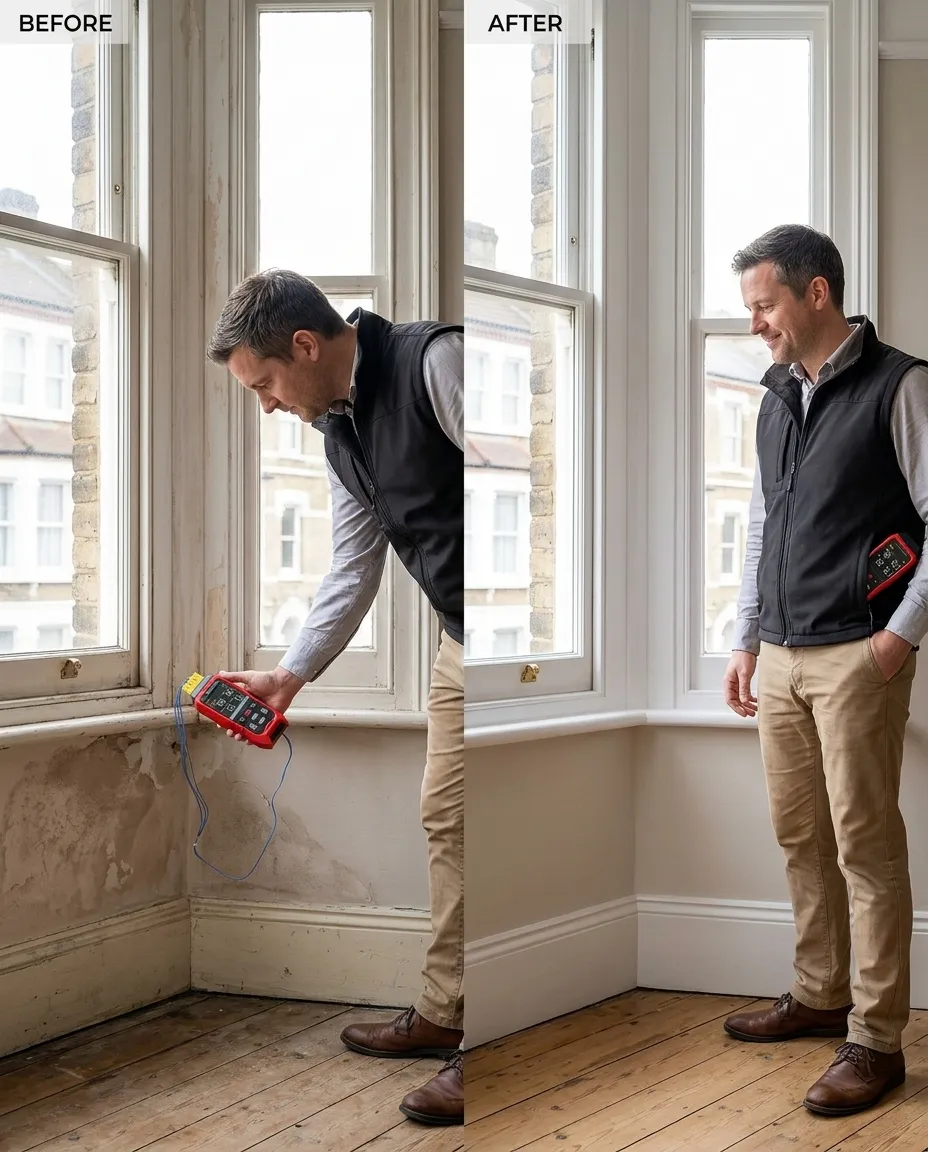
Testing with a thermocouple meter involves connecting your probe, selecting the correct sensor type, and verifying against a known reference point. Get these three steps right and you're sorted.
Basic Connection and Setup
Plug your K type probe into the miniature thermocouple connector — the flat pin is positive (chromel, yellow in UK colour coding per BS 1843). Switch your meter to K type mode. Some multi-input meters also accept J, T, E, R, S, and N types, so double-check. Wrong type selection gives wildly incorrect readings — I've seen a 47°C error from someone who left their meter on J type with a K probe connected.
Verification Against Known References
Before trusting any measurement, verify against at least one known point:
- Ice point (0.0°C): Crushed ice and distilled water in a vacuum flask. Should read 0.0°C ±0.5°C.
- Boiling point (~99.6°C at sea level in Belfast): Adjust for local atmospheric pressure. At 1013 hPa, pure water boils at 100.0°C.
- Dry-well calibrator: Purpose-built blocks accurate to ±0.1°C. Worth the investment if you're testing regularly.
Honestly, I've tried skipping the ice bath check when I'm in a rush. Don't. It takes three minutes and catches drift before it becomes a problem on site., a favourite among Britain’s tradespeople
Reading Stabilisation
Allow 30–90 seconds for the reading to stabilise, depending on probe mass and thermal contact. Exposed junction probes respond in under 5 seconds. Grounded sheathed probes take 15–30 seconds. Ungrounded sheathed probes — the slowest — can need 60+ seconds for a stable reading. If your meter has a MAX/MIN hold function, use it to capture peak temperatures during transient measurements.
For professionals using an industrial pyrometer or ir pyrometer alongside contact probes, the thermocouple reading serves as your ground truth. An infrared pyrometer can be affected by emissivity variations, surface finish, and viewing angle. Your contact thermocouple meter reading doesn't lie — assuming it's calibrated properly.
Step-by-Step Calibration Guide for Digital Thermocouple Meters
Calibration confirms your meter reads within its stated accuracy specification by comparing it against traceable reference standards. UK laboratories follow BSI standards (specifically BS EN 60584-1:2013 for thermocouple reference tables) when performing UKAS-accredited calibrations.
You can perform a field verification yourself. Here's how I do it, and it's the same process recommended in our full calibration walkthrough.
Equipment You'll Need
- UKAS-traceable reference thermometer (±0.02°C or better)
- Dry-well calibrator or stirred liquid bath
- Ice point reference (Dewar flask, crushed ice, distilled water)
- Calibration certificate for your reference standard
- Record sheet or calibration management software
Procedure (5-Point Calibration)
- Set your calibrator to 0°C. Insert both the reference probe and the unit under test. Wait for stabilisation (minimum 3 minutes at each point). Record both readings.
- Move to 100°C. Same process. Note the deviation.
- Move to 250°C. This catches mid-range linearity errors that ice/boil checks miss.
- Move to 500°C. Critical for industrial users. Deviation here often indicates probe degradation rather than meter error.
- Return to 0°C. Confirms no hysteresis in the system. If the return reading differs from your initial 0°C by more than 0.3°C, investigate the probe.
Acceptable tolerances (field calibration, 2026):
- 0°C point: ±0.5°C
- 100°C point: ±0.8°C
- 250°C point: ±1.5°C
- 500°C point: ±2.5°C
If deviations exceed these values, the meter or probe requires professional recalibration or replacement.
Calibration Interval
The Health and Safety Executive doesn't mandate a specific interval for thermocouple calibration, but industry best practice in the UK is every 12 months for meters and every 6 months for probes in heavy use. Food manufacturing sites often calibrate quarterly. Document everything — traceability matters when auditors come knocking.
Is a proper dry-well calibrator worth the extra spend? Yes, without question. A decent portable unit costs £400–£1,200 but pays for itself within a year if you're managing multiple instruments. Sending meters out for UKAS calibration runs £80–£150 per certificate.
Choosing the Right Thermocouple Meter for UK Applications
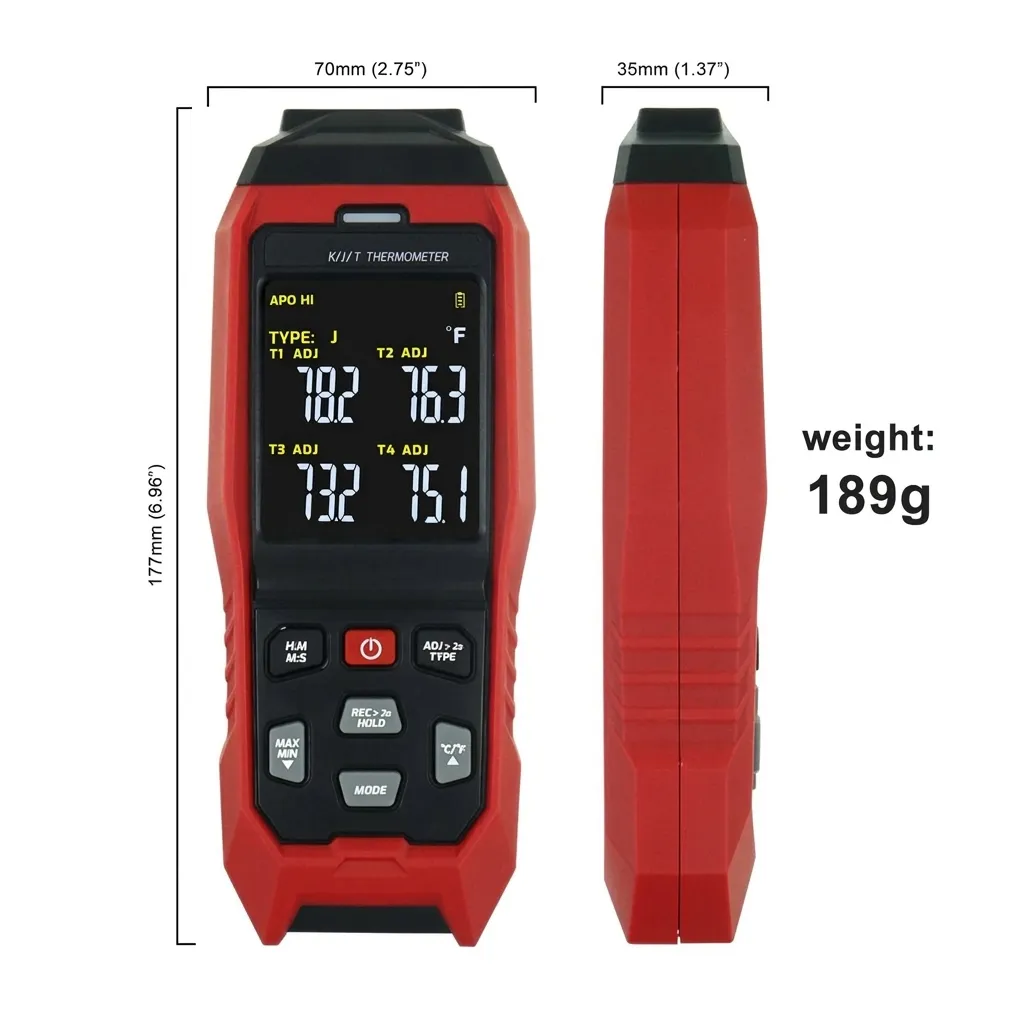
The right meter depends on your measurement range, required accuracy, number of channels, and whether you need data logging. Single-channel handheld units suit spot checks. Multi-channel loggers suit process monitoring.
Look, I know the price seems steep when you see professional-grade meters at £150–£400, but hear me out. A cheap £20 unit from a marketplace seller might read 3–4°C off at 200°C. In food safety, that's the difference between compliance and a closure notice. In HVAC commissioning, it's the difference between a balanced system and callbacks.
Key Features to Look For
- Input channels: Single for spot checks, 4-channel for process monitoring (competitors offer 4-channel data loggers recording 500,000 readings per channel)
- Data logging: Internal memory or USB/Wi-Fi export. Essential for audit trails.
- Thermocouple type compatibility: K and J minimum. T, E, R, S, N for specialist work.
- IP rating: IP54 minimum for site work. IP67 if you're near water.
- Battery life: 200+ hours for handheld units. USB power option for loggers.
- Cold junction accuracy: ±0.2°C or better. This is where cheap meters fall down.
When you buy measuring instruments online UK from gainexpress, you're getting instruments with proper specifications and UK-based support. That matters when you need a calibration certificate or technical guidance on probe selection.
Complementary Instruments
A thermocouple meter rarely works alone. Most professionals pair it with an industrial infrared thermometer for non-contact screening, then verify hot spots with the contact probe. For building diagnostics, a 3 in 1 soil moisture light ph meter or dedicated moisture meter helps identify damp issues that affect thermal performance — relevant if you're investigating why a heating system isn't performing after you've balanced your radiators.
A high temperature pyrometer or hand held pyrometer covers the non-contact side for readings above 1000°C where even K type probes struggle with longevity. For window and glazing assessments, a VLT meter for window tint measures visible light transmission — different application entirely, but often needed on the same building survey.
Industrial and HVAC Applications in the UK
UK engineers use thermocouple meters across manufacturing, food processing, HVAC commissioning, and building services. Each sector has specific requirements driven by British Standards and HSE guidance., popular across England
HVAC Commissioning
Measuring flow and return temperatures on heating circuits requires ±0.5°C accuracy to calculate proper ΔT values. A 10°C differential across a radiator circuit indicates correct flow. Less than 6°C suggests the system needs balancing. I've watched heating engineers on the Shankill Road spend hours with lockshield valves because their temperature readings were unreliable. A proper K type meter with surface probes makes this job straightforward.
Pairing your contact meter with a non-contact thermometer for HVAC speeds up initial screening. Scan the pipework with an IR gun, then confirm suspect readings with your thermocouple probe. The IR reading might be off by 3–5°C due to emissivity of copper pipe, but it tells you where to look.
Food Safety and Cold Chain
UK food safety regulations require temperature monitoring at critical control points. Probe thermometers must be calibrated and traceable. A K type thermocouple meter with a penetration probe gives readings in under 10 seconds — faster than thermistors, and more solid in commercial kitchen environments where probes get dropped, bent, and abused daily. (Anyone who's worked a busy service knows exactly what that looks like.)
Process Manufacturing
Plastics extrusion, heat treatment, ceramics firing — these processes demand continuous monitoring at multiple points. Four-channel thermocouple data loggers record temperature profiles over entire production runs. The data proves process compliance and identifies drift before it causes rejects. This spring, several UK manufacturers have upgraded from single-point spot checks to continuous logging as part of ISO 9001:2015 quality management improvements.
Understanding How to Use a Soil Moisture Meter in Context
Might seem unrelated, but building diagnostics often combine thermal and moisture measurements. If you're investigating condensation or mould issues — and based on what I've read from homeowners dealing with recurring damp problems — knowing how to use a soil moisture meter on walls and floors gives you the full picture alongside your temperature data. Rising damp affects thermal performance. Cold spots cause condensation. The two measurements work together.
Frequently Asked Questions
What accuracy can I expect from a K type thermocouple meter?
A quality K type thermocouple meter achieves ±0.5°C accuracy at room temperature, with total system accuracy of ±1.5°C or ±0.4% of reading (whichever is greater) across the full range per IEC 60584 Class 1. Budget meters typically manage ±2.5°C. Cold junction compensation quality is the main differentiator between price points.
How often should I calibrate my thermocouple meter in the UK?
Industry standard in the UK is annual calibration for the meter and six-monthly for probes under heavy use. Food manufacturing and pharmaceutical sites often require quarterly checks. UKAS-accredited calibration costs £80–£150 per certificate. Always verify against an ice point between formal calibrations — it takes three minutes and catches drift early.
Can I use a J type probe with a K type thermocouple meter?
Only if your meter supports multiple thermocouple types and you select J type in the settings. Using a J type probe while the meter is set to K type produces errors of approximately 2–5°C at 200°C, increasing at higher temperatures. The connectors are physically different sizes to prevent accidental cross-connection, but adapters exist — use them carefully.
What's the difference between a thermocouple meter and an infrared pyrometer?
A thermocouple meter requires physical contact with the surface or medium being measured, giving true temperature readings regardless of surface properties. An infrared pyrometer measures emitted thermal radiation without contact but is affected by emissivity, distance, and surface finish. Most professionals use both — the IR pyrometer for rapid screening and the thermocouple for verification at ±0.5°C accuracy.
Which thermocouple type is best for HVAC work in the UK?
K type is the standard choice for UK HVAC applications. Its range of −200°C to +1372°C covers everything from refrigeration systems (−40°C) to flue gas analysis (+300°C). K type probes are widely available, affordable at £8–£25 for standard models, and compatible with virtually all handheld meters sold in the UK market as of 2026.
Do I need a data logging thermocouple meter?
If you need to demonstrate compliance, monitor processes over time, or troubleshoot intermittent temperature issues, yes. Data loggers record continuously — some storing 500,000 readings per channel — and export via USB or Wi-Fi for analysis. For simple spot checks during maintenance or commissioning, a standard handheld meter without logging is sufficient and costs £50–£150 less.
Key Takeaways
- K type thermocouples cover −200°C to +1372°C and are the UK industry default for HVAC, food safety, and general industrial temperature measurement.
- J type offers 27% higher sensitivity but is limited to 760°C maximum and degrades in oxidising or damp environments — choose based on your specific application.
- Calibrate meters annually and probes every 6 months as minimum UK best practice, with quarterly checks for food and pharmaceutical applications.
- Cold junction compensation quality is the single biggest accuracy differentiator between budget and professional thermocouple meters — expect ±0.5°C vs ±2.5°C.
- Always verify against an ice point (0.0°C) before critical measurements — it takes 3 minutes and catches drift that could invalidate your readings.
- Pair contact thermocouple measurements with non-contact IR readings for efficient workflow: screen with the pyrometer, confirm with the probe.
- Four-channel data loggers recording 500,000+ readings per channel are now the standard for UK process monitoring and ISO 9001 compliance in 2026.
Ready to try GainExpress?
Shop Now — £71.37